BUILD YOUR OWN with Kangan Arora
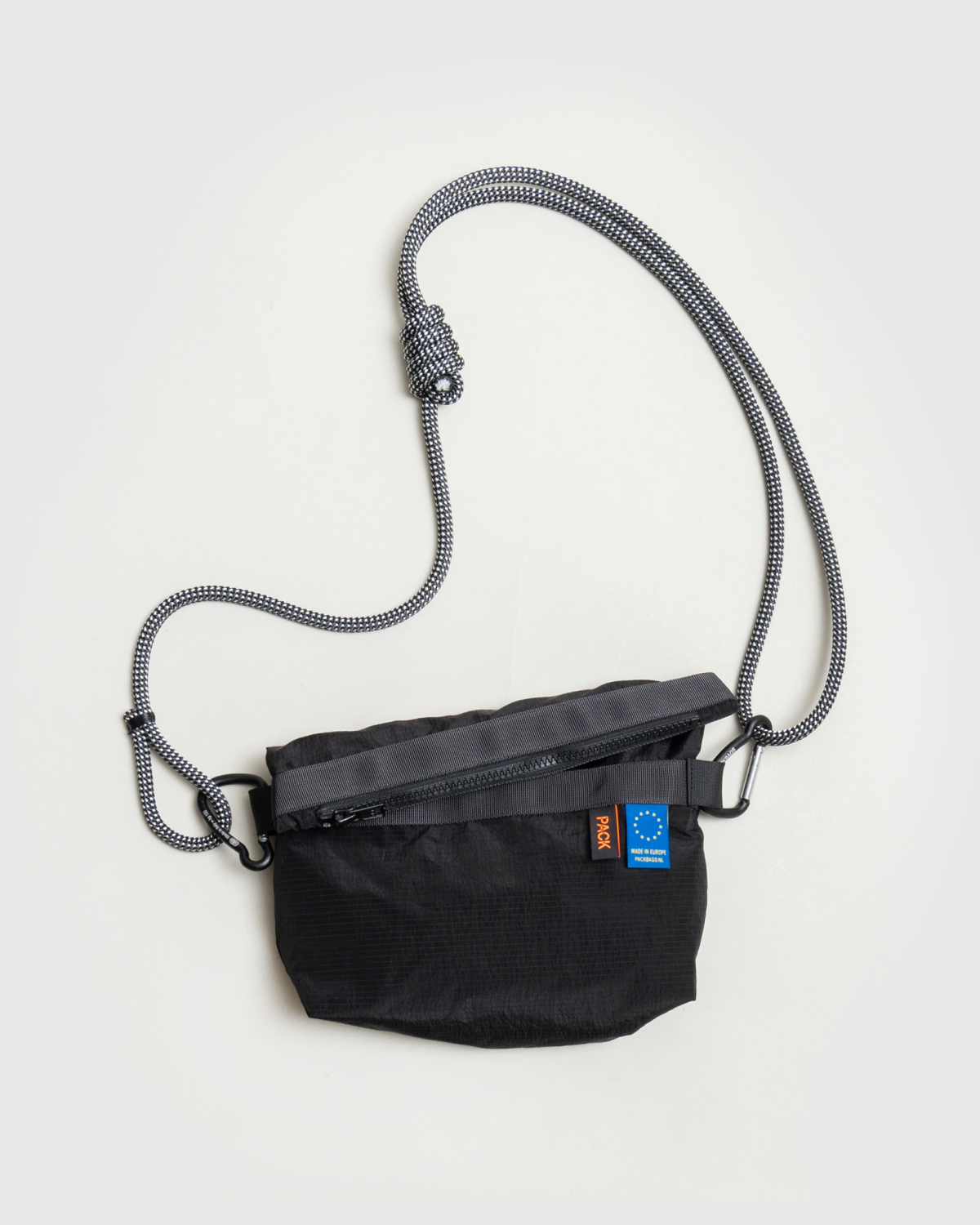
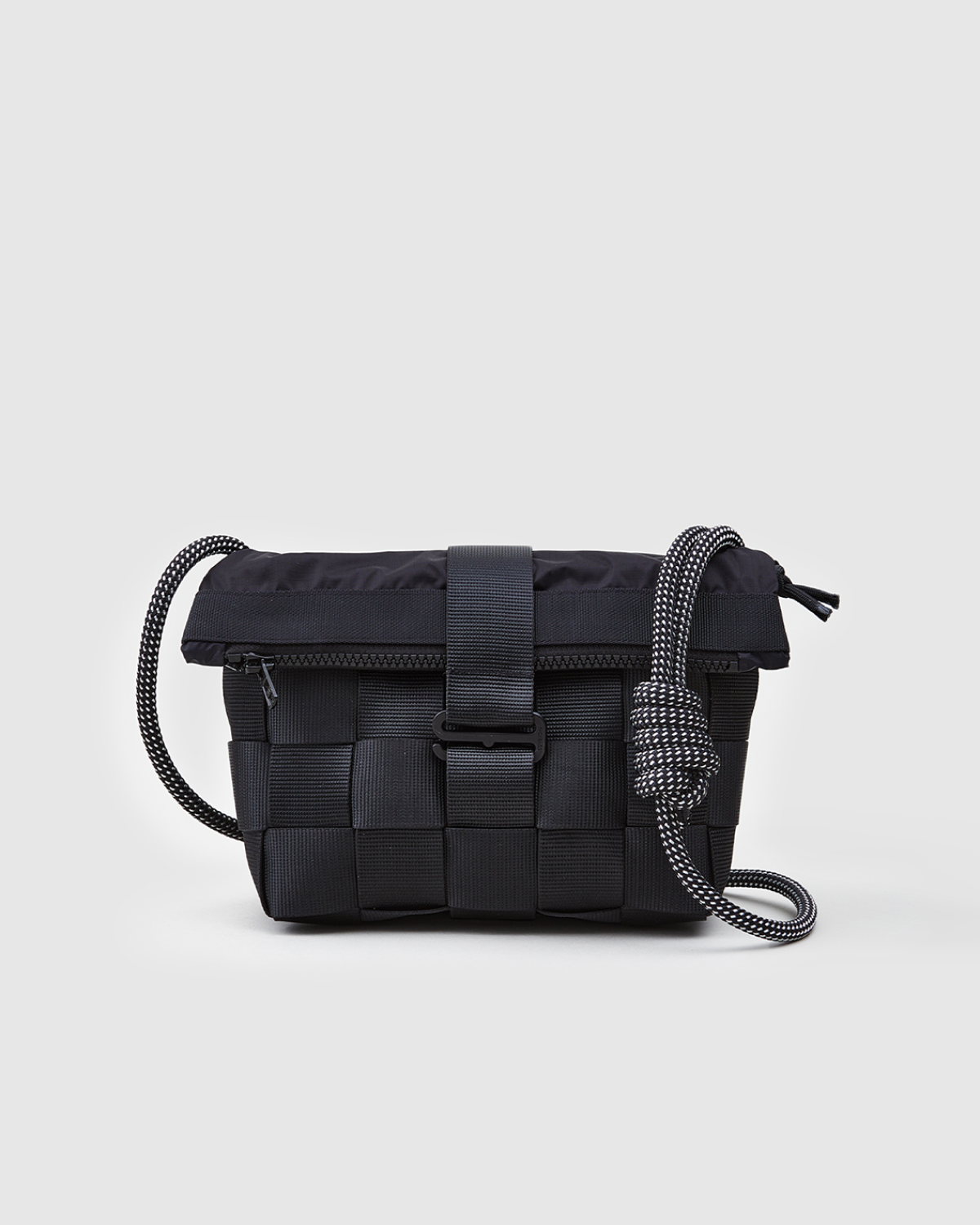
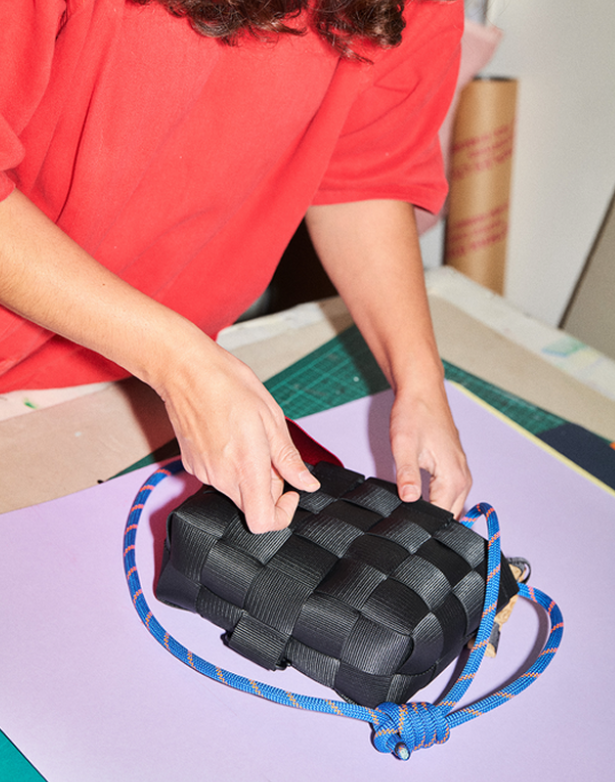
Textile designer Kangan Arora on why and how she built the A201//WIDE WEB.SMALL.RECTANGLE BASKET SLING
BUILD YOUR OWN with Kangan Arora
Textile designer Kangan Arora on why and how she built the A201//WIDE WEB.SMALL.RECTANGLE BASKET SLING
BUILD YOUR OWN with Kangan Arora
Kangan Arora is a London-based textile artist and designer whose work explores colour, geometry, and the culture of the everyday. Her practice moves fluidly between art and design; from large-scale installations like the Exchange House tapestries in London and The Beacon Feature Curtain for Bradford 2025, to collaborations with Tate Gallery, IKEA, and Floor_Story.
What kind of designer are you?
“I’m a designer who likes making and process, always with a big focus on colour. I have to physically work with materials: screen-printing, collaging, cutting, stitching, for it to come together for me. I’m a strong advocate of thinking through making, and I use this approach no matter what the outcome is: rugs, art installations, tapestries.”


You picked the A201//WIDE WEB.SMALL.RECTANGLE BASKET SLING, why?
“I’ve carried around one of your basket weave laptop cases since 2019 and I love it so much, so I jumped at the chance of adding the basket bag to my day-to-day as a small sling bag. It’s the perfect size to carry everyday essentials. I also really enjoyed how the ‘build your bag’ gave me an opportunity to put some colours together which is my favourite pastime.”


What was the last thing you made or repaired?
“A range of textile works for an exhibition called Conversations in Colour that I curated with my friend Caitlin Hinselwood. These started as little colour studies with found fabric and were realised as one-off quilts and wall hangings inspired by kites.”

What is your favourite tool?
“My Japanese circle cutter that doesn’t leave a point. It’s meant for paper — I ruined one trying fabric! But it’s very therapeutic. Sometimes I just sit and cut circles out of paper. I use a lot of geometry in my work, and this tool gives perfect circles without the little pinhole you get from a compass. I found it in Japan when I was running a workshop at the Tokyo Design Lab — they had the most amazing stationery shop. I still use it now.”


What do you put in your bag on an average day?
“Keys, glasses case, phone, wallet, pen and a little notebook.”

ABOUT US
PACKBAGS is built on a brutally simple idea: 100 modules - no more. With this modular system, you can design anything you need to pack everything you want. Each bag is built from individual modules, so if one part wears off, you simply replace it. Change the layout, swap components, or choose a preset configuration: the system is fluid, just like your personality.
This modular approach is our answer to overconsumption. By limiting the system to 100 modules, we encourage intentional choices while unlocking infinite possibilities.
Playful, practical, and visually bold: our message might be moderation, but our aesthetics stand out firmly.
PACKBAGS was founded in 2012 by Alei Verspoor with a clear intention: create a design system that reduces waste and evolves with its user. That intention still guides us today.
All PACKBAGS are made by hand in our Amsterdam atelier. Our method is rooted in the traditional craft of basketmaking, combined with modern materials and techniques to achieve true modularity. We work with trusted European suppliers, from the Netherlands, the UK, Germany, Italy, and Spain and continue to explore sustainable alternatives wherever possible. Durability and longevity always lead.
100 modules. Infinite possibilities. Made in Amsterdam, The Netherlands.


PACKBAGS x Rein Reitsma
We’re proud to introduce PACKBAGS × Rein Reitsma, a limited collaboration celebrating our shared love of craft, playful design, and functional basket modules handmade in Rein’s Rotterdam studio.
PACKBAGS x Rein Reitsma
We’re proud to introduce PACKBAGS × Rein Reitsma, a limited collaboration celebrating our shared love of craft, playful design, and functional basket modules handmade in Rein’s Rotterdam studio.
PACKBAGS x Rein Reitsma
|
BUILD YOUR OWN with Lex Pott
Designer Lex Pott on why and how he built the A301//WIDE WEB.ROLLTOP BASKET BACKPACK.
BUILD YOUR OWN with Lex Pott
Designer Lex Pott on why and how he built the A301//WIDE WEB.ROLLTOP BASKET BACKPACK.
BUILD YOUR OWN with Lex Pott
At PACKBAGS, we love to hear how designers connect with our system. This time, we spoke with Dutch designer Lex Pott (1985), known for his raw and intuitive approach to materials. From wood and stone to metal, Lex strips design back to its essence. Here, he shares his thoughts on tools, making, and why the A301 2IN1 Rolltop Basket Backpack is his pick from our collection.

What kind of designer are you?
“I would describe myself as a very hands-on designer that works from materials, from techniques and experimental approaches, of reproducibility. So understanding industry, understanding how things are made.”
You picked the ‘A301 2IN1 ROLLTOP BASKET BACKPACK’ with a gradient closing strap, why?
“I have a personal link to the bag because I’ve worked with weaving webbing straps in my own work as well - the checkered furniture. I love that it’s an industrial material, even produced in The Netherlands, which is used in a new context. The design is very intelligent because the structure of weaving became the functionality.
I picked this color because black is timeless and the gradient strap gives it a personal accent.”


What was the last thing you made or repaired?
“A vacuum cleaner I had for 15 years. It didn't work anymore and then my first reflex was to discard it and trash it and buy a new one. Then I thought, come on, what a waste. It's such a good machine. There must be a way to fix it. And then I checked a bit what was wrong and it was a 90 cent plug that I replaced and it worked again. I felt it was very satisfying that for 90 cents you expand the lifespan by another 10 years.”
What is your favourite ‘tool’?
“I would say a lathe or a chop saw. Funny enough, those two machines have brought me most products, because the machines are capable of doing so much. And they are also very, let's say, a prototype for industry. I constantly buy and sell machines that I use for a prototype, but then I don't need them anymore. But the lathe and the chop saw I always keep.”

What do you put in your bag on an average day?
“There needs to be a pen and a paper. I can bring my laptop or leave it home but it's usually in there and for the rest it's scribbling papers. I'm always a light traveller so a backpack is perfect to bring the necessary things.”
Favourite place?
“Honestly, at home on the sofa. I'm a huismus (couch potato).”

Your favourite song/sound?
“I would say is rain on the roof. I always love it because it makes you feel protected inside, isolated, but it's messy and rainy outside. And the fireplace. Like the crackling of wood. Let's say.”
Lex Pott’s focus on materials, repair, and honest design reflects the same values behind PACKBAGS. With our 100-module system, we invite people to design intentionally, replace only what wears out, and keep using what works. Just like fixing a vacuum with a 90-cent part, small choices can extend life and reduce waste — while still leaving room for personality and play.

PACKBAGS X VODDENMANNEN
We teamed up with Voddenmannen to transform discarded garments into 15 exclusive fold pouches for our modular system.
PACKBAGS X VODDENMANNEN
We teamed up with Voddenmannen to transform discarded garments into 15 exclusive fold pouches for our modular system.
PACKBAGS X VODDENMANNEN
At PACKBAGS, we design with limits: 100 modules, no more. Within that frame, anything is possible. This mindset connects naturally with Voddenmannen, the initiative of Amsterdam-based designer Rens de Waal. Known as a “Fashion Remodelist”, Rens transforms discarded garments into new, intuitive pieces.
Last year, we teamed up with him to create something special. Using his signature remodelling technique, Rens crafted 15 exclusive fold pouches designed for the PACKBAGS modular system. Each piece started as a discarded post-consumer garment. After cleaning and reworking, the fabric became part of a small batch of highly functional, one-of-a-kind designs.

DISCARDED POST-CONSUMER PRODUCT TRANSFORMED TO DESIGNER ITEMS
Voddenmannen is an initiative of fashion designer Rens de Waal in which he investigates his role as a ‘Fashion Remodelist’, a mentality in which we look at the value of clothing in a different way. Voddenmannen is a reaction on vintage items with minor defects starting with what kind of amends the existing items require. He then develops several intuitive design solutions to renew and transform the garments. This results in an easy to wear product with a recognizable handwriting.
voddenmannen is based in Amsterdam and operates on a local scale. After the selection process of discarded post consumer product, the items are cleaned and re- modeled until a full batch of voddenmannen items is ready to be sold. The making process of a new batch takes about 3 months after which a pop-up moment is organized in the city where the items are sold by the maker straight to the audience.


Friday the 29th of November 2024 we held a pop up in Amsterdam to present these pieces.